"Dragons of the Empress" Hussar 
Another character that appears in "The Charge of the Mamelukes", by Goya, is a Dragon Guard.
These soldiers were light cavalry soldiers trained to fight both on horseback and on foot. They were armed with a straight sword, a pistol and a rifle on which you could fit a bayonet. The models of these weapons varied depending on the regiment and, in some cases, instead of a musket rifle was used. Generally, in most units, the rifle was the model of 1,777, with a longit 141.7 cm ud. and weight of 4.3 kg. Guns, model years XIII and IX, measuring 33 and 35 cm. respectively, weighed 1.3 kg and were of the caliber 1.71. All weapons were used on foot or on horseback, so the dragon did not stem the sword for operations on foot.
dragon's performance was very discreet during the first part of the Napoleonic Wars, and Napoleon was very unhappy with the officers of the body. He felt that his desire to shine, I had to design a dramatic statement, but in the battlefield only produced disorder. However, on 8 October 1805 occupied dragons, house by house, the town of Wertingen, allowing the subsequent occupation of Augsburg, and facilitated the operations that eventually led to the victory of Austerlitz, two months later.
The April 15, 1806 Napoleon's imperial order creating the regiment Dragons Imperial Guard , it formed part of the Imperial Guard.
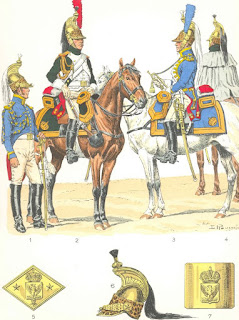
were presented publicly for the first Once in the Plaza Carrousel, and the empress was so impressed he decided to become the godmother of the new body. His desire became in a gift from Napoleon to Josephine, and for this reason is called an unofficial "Dragoon Regiment of the Empress."
This regiment was designed to be an elite team, made up mostly of veterans with at least 6 years of service. Later this requirement reached 10 years of service. It was also necessary to have participated in at least two campaigns, read and write and be at least 173 centimeters. Jean Arrighi de Casanova Toussiaint was his first charge and was responsible for organizing the regiment and to design the uniforms. Among other things, determined that the Dragons were riding black horses, but finally was unable to fulfill this condition and black horse únicamentedisponían some units. The rest used to ride horses, bay or chestnut.
The regiment was made up of 4 squadrons tions, each composed of 200 dragons and 50 candles. Led by 60 officers. On 9 December 1813 was added a squadron of Éclaireurs (explorers) .

The distinctive feature of the uniform of the dragoons was a copper helmet crest topped with a black tassel adorned with horse hair, also black . The horsehair was used as protection from the blows of the enemy sword in the head, entangled in it. Sometimes could be a side boom. The bottom of the hull was covered with sealskin band called turban. The visor was made of leather. The warrior was green and the color of the neck, bib, cuffs and shoulder pads depended on the regiment. Also varied depending on the regiment's position flap pockets of wars, which could be vertical or horizontal.
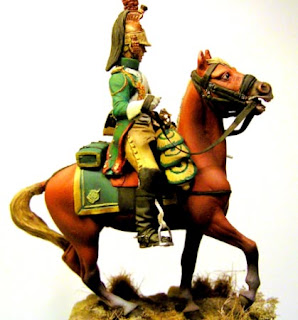
In the case of the officers forage yellow motif formed by a number of strands twisted and held by the ends to the shoulder and chest of the warrior, were golden .
trousers were wearing white leather boots on the horse service. In the service of foot were exchanged for leggings and gloves are dispensed with, something that was not the case with the officers. Another difference was that the officers for not carrying the service pack on foot.
The dress uniform of the horns (a horse) is formed by a helmet with horsehair tassel and white and blue feather. The warrior was white collar, blue overalls and turns. The pants and boots are the same as the rest of the troops. The horse was white by regulation.
For musicians on foot (eg, trumpet), the colors of the warrior invested, going to take as the color of his tunic the color of the regiment and the rest (neck, bib, cuffs and shoulder pads) green.
The frame was equipped with two front bags, a blanket and a portmanteau square, all edged with green and yellow for the troops and gold for officers.
portmanteau appeared in the regimental number. All belts were white uniform, including rifle strap and backpack straps. Not the case with the straps of the saddle. The head and gripping the rifle on the horse were black leather, brown chair and strap and white bracket action.
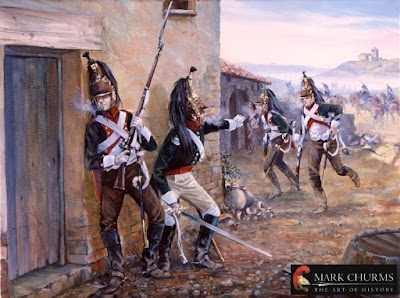
fought in Spain from 1,808 to 1,810. As a unit of fast motion and also trained to perform their duties on foot, were mobilized on many occasions during the confrontation.


